Sliding Glass Panels in Art Deco and Streamline Moderne Design
Sellers on antique sites occasionally list Art Deco and Streamline Moderne era furniture that has sliding, frameless glass pane doors. Many sources suggest that this is a Midcentury Modern (MCM) style when used on home furniture. It it certainly true that the design was popular that period (1950s - 1960s). According to a reasonably good online article about sliding doors and MCM,
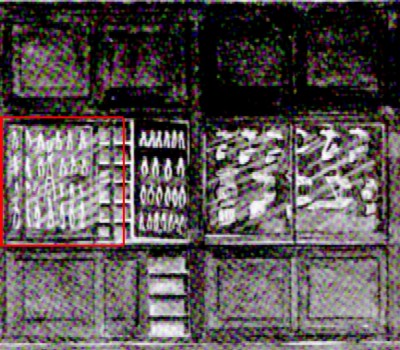
Display Case with Framed Sliding Glass Doors, From Hardware Dealers'
Magazine, Vol. 38, 1912. p. 591
The architects and designers of the mid-century modern era placed significant emphasis on the importance of natural light in interior spaces. By incorporating large windows and sliding doors, they were able to create bright and airy spaces that promoted a feeling of well-being and harmony with nature. Sliding doors, in particular, were an efficient way to invite more light into the home. ("The Role of Sliding Doors in Mid-Century Modern Design", Aluminum Windows and Doors website, gathered 5-25-25)
Yet the design existed well before the 1920s. A description of sliding glass doors in home from a March 1905 article describes "a veranda enclosed in sliding glass frames. ...At the top of the veranda, inside, were attached ...boards with the tracks inverted so as to guide the glass frames at the top as well as the bottom" ("Taking the Cure Alone" The Outdoor Life, 1905, p. 44) These are clearly wood framed panes of glass, the logical first step in creating glass doors. Sliding glass doors in separate frames (so that they could pass by each other to allow for the largest opening possible) were also used in store displays in the early 1910s as seen in the image at right. So this was not a new idea in the Art Deco 1920s. As early as 1921, architect Rudolph M. Schindler used wood-framed sliding canvas patio doors in a house in West Hollywood, California.
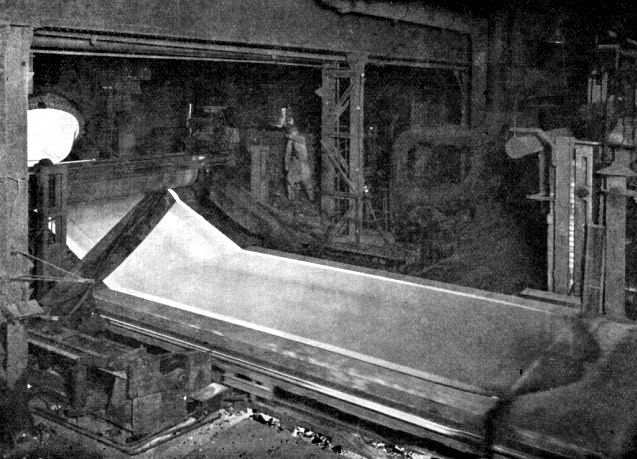
Casting Molten Plate Glass, From Major R. M. Wilks, "The Making of a Sheet of Glass", 1933, p. 20
A problem with glass doors in the 1910s and early 1920s was the glass itself. Flat glass was manufactured either by casting molten glass and pressing it with rollers or drawing a semi-molten glass out of a furnace in a continuous ribbon and cutting it to size. To produce an acceptably transparent glass from the pressed process required grinding the surfaces. The drawn process resulted in small pieces of glass with a wavy finish. Yet by 1925 both processes had been improved and perfected; the pressed process by Pilkington and the drawn process by Libbey-Owens and Pittsburgh glass. This allowed reasonably clear flat glass to be produced in a variety of sizes using both processes.
Open, airy space was a facet of International Style, which had its roots in Modernism. As it pertains to interior design and architecture, Modernism embraced the idea that 'form follows function', eschewing ornamentation in its severest forms. It embraced clean lines, open space and modern materials such as concrete, steel and glass. It emerged in the 1920s with designers such as Le Corbusier, Alfred Loos, Pierre

Sliding Glass Windows Dividing the Smoking Room From the Bar, Grand Hotel,
Pierre Chareau, Photo: Therese Bonney, 1927, Smithsonian Institute
Chareau and Frank Lloyd Wright and others embracing the tenets of the style. It impacted both the 1930s and 40s Streamline Moderne and 1940s - 60s Mid-century Modern styles, removing some of the ornamentation of the Art Deco designs and adding more openness. The expanded use of sliding glass panels suited the Modernist design style well.
Although sliding glass doors had been used in furniture previously, the improvement of glass production allowed designers and architects to begin building structures with sliding glass windows. In July 1926, Le Corbusier and Pierre Jeanneret engineered and patented a sliding window with several free moving framed windows, which they used on the Maison Cook in Boulogne-sur-Seine, France. (Their system had the grooves in the windows rather than in the window molding as seen in the image below. This design is far too complicated - not to mention expensive - to be implmented in most cabinets.)
In 1927 Pierre Chareau used "a screen of [framed] sliding curved glass panels extending from floor to ceiling" to separate the bar from the smoking room at the Grand Hotel of Tours. (Howell S. Cresswell, "The Autumn Salon, 1927", Good Furniture Magazine, January, 1928, p. 24) [See the image at left.] An article in the American magazine Country Homes from 1927 advises, "The country house dining room must always aim to bring as much of the outdoors inside as possible. Its ideal location is directly off the veranda and separated from it by sliding glass doors or long French windows." ("Furnishing the House in Summer", Country Homes, July/August 1927, p. 16) The sliding glass pane was now part of house design. A variety of buildings included sliding glass patio doors by the mid-1930s.
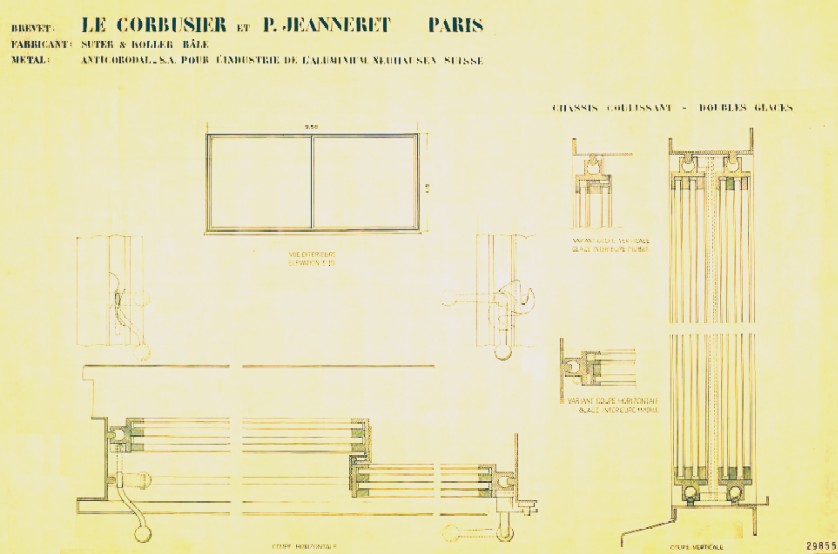
Sliding Glass Windows, Le Corbusier and Pierre Jeanneret, for Maison Cook, Designed in 1927, FLC29855. © FLC
The use of sliding glass doors and windows in architecture does not really answer the question of when frameless sliding flat glass doors appeared on furniture. Following multiple attempts to restate a query to Google on this point, the AI finally admitted that it was difficult to be certain, but it was likely around the same time that sliding glass doors appeared in walls.

Sliding Glass Door Display Cabinet for the Century of Progress
World's Fair, Rosewood, Mahogan and Birch with Glass Doors,
Sides and Shelves, Signed Wolfgang Hoffmann, 1933, Chairish
(And if you can't trust AI... well... actually, you can't.) Since we know sliding glass windows were around in homes in the mid-1920s and in store furniture in the 1910s, it seems like a small step for some intrepid furniture designer to use them in home furniture. One enticing example from 1931 mentions "A china cabinet built into the wall [of a house]... protected with sliding glass windows." (Furniture Decoration, July, 1931, p. 78) However, without a photo, it is impossible to say how this design worked. (It does at least proved that some form of sliding glass door on a cabinet existed as early as 1931, though.)
Fortunately, we do have a period example of a signed cabinet with sliding glass panes from known designer displaying at the 1933 Chicago 'Century of Progress' World's Fair - the event considered by many to be the introduction of the Streamline Moderne style to America. At left is a cabinet with drawers on the bottom and a sliding glass display cabinet on top by Wolfgang Hoffman.As the seller explains, it has the "Signed, original label to drawer interior, featuring 1933 World's Fair mark impressed."
Of course, it is difficult to to be certain whether specific cabinets featuring frameless sliding glass doors were from the Art Deco or (more likely) Streamline Moderne period. They appear in several pieces on the internet which are identified as dating to the 1920s or 30s. Of course, a seller can say whatever they think will appeal to buyers. I have even seen one seller try to explain the presence of sliding glass doors by suggesting that they were added later.
Below are several examples of what sellers currently list as Art Deco style furniture with sliding glass doors. Some may be transition pieces (Streamline - MCM) and/or may not not be dated correctly, but a couple really look like they belong to the Art Deco era. Dating such designs to the 1920s seems a bit early, although it must be remembered that sliding glass framed doors appeared in the 1910s, so it is not out of the question that this style could have appeared in the 1920s.
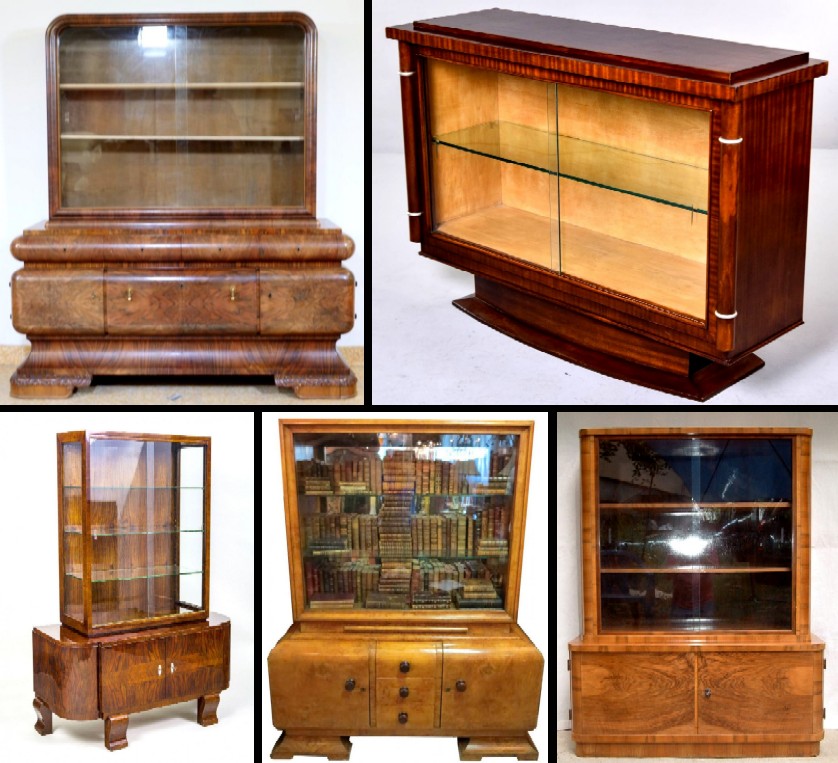
Display Cases with Sliding Glass Doors from Internet Sellers, from left - German Cabinet, Walnut Veneer and Glass, 1920s, Pamono; French Cabinet, Possibly Palisander and Maple or Beech with Glass, Pedestal Base, Cross-Banded Veneer Edge, Judy Frankel Antiques; Display Cabinet, Oak, Mirror, Glass, French, 1920s, Vintage; Streamlined Cabinet, Bird's-Eye Maple, Glass, Mirrored Back, 1930s, Modernism; Cabinet, Burl Walnut Veneer, Glass, Brass Hardware, 1920s-30s, Hungary4Deco
Sources Not Mentioned Above:
Carlos Machado e Moura & Pedro Borges de Araújo, "The horizontal sliding glass window/wall in the 20th century, a long technical and architectural evolution", Technical and Architectural History of the Minimalist Window, Building Views website, gathered 5-29-25 - https://www.buildingviews.net/essay/brief-technical-architectural-history-minimalist-window/the-horizontal-sliding-glass-window-wall-in-the-20th-century-a-long-technical-and-architectural-evolution/
"Sliding glass door", Wikipedia, gathered 5-26-25
"Modernism", Wikipedia, gathered 5-29-25
"International Style", Wikipedia, gathered 5-29-25
"Mid-century modern", Wikipedia, gathered 5-29-25
Original Facebook Group Posting